Top 5 Considerations for Connecting Indoor and Outdoor Spaces in Your Home

There is something fundamental about the way a well-designed home opens to the outside. Natural light that shifts through the day. Fresh air moving through the rooms. A view that reminds you where you are.
In Boulder, Colorado, our clients live with the Flatirons as a backdrop. In Idaho's Wood River Valley, they are surrounded by mountain terrain that changes with every season. These are extraordinary natural environments, and the homes we design are meant to be genuinely connected to them.
But before we talk about how to connect indoor and outdoor spaces, it is worth stepping back. The most common mistake we see is assuming that more connection is always better. More glass, more openings, more access. The quality and intention behind each connection matters far more than the quantity.
Below are the five considerations we work through with every client, whether they are building a custom home or transforming an existing one.
Step 1: Start with the Right Questions, Not the Biggest Openings

Intent Before Product
The first conversation we have with clients about connecting indoor and outdoor spaces is rarely about doors or windows. It is about intent.
What kind of connection are you actually looking for? Should it be visual or physical? Expansive or focused? Constant or elective? These are not small distinctions, and the answers shape every decision that follows.
More Is Not Always Better
A bedroom that frames a specific view through a carefully placed window serves its occupant differently than a living room that opens entirely to a patio. Both are valid. Neither is automatically better.
A single, well-considered connection often has more impact than glass on every wall. When every room offers the same sweeping view, the experience flattens. When a connection is specific and intentional, it means something.
We Design Around How You Live
Our goal is never the most dramatic indoor-outdoor statement we can make. It is the most fitting one; shaped by your site, your lifestyle, and how you actually use each space. That is the foundation every good indoor-outdoor connection is built on.
The slender opening allows a shaft of daylight to flood into the space, while offering a connection to the often-blue sky above.
Step 2: Let the Site Tell You What's Possible

The Work That Happens Before Design
Every project site is unique. Before we place a single window or move a wall, we investigate what the site is actually telling us. Topography, orientation, view corridors, privacy considerations, neighboring structures, zoning constraints; all of it gets catalogued and understood before any design decisions are made.
This is the work most people do not see. It is also the work that makes everything else possible.
The Landscape as Design Information
In Boulder and the surrounding Colorado foothills, the landscape is not a backdrop. It is a participant. The direction the Flatirons sit relative to your lot, the arc of the sun across a Colorado sky, the way light behaves differently in each season, these are not incidental details. They are design information.
The same is true in Idaho's Wood River Valley, where terrain and orientation shape every decision about where connections belong and what they should look like. Understanding these landscapes deeply, and designing within them specifically, is one of the things that defines how we work.
What Are You Actually Connecting To?
A thorough site analysis also clarifies something that sounds straightforward but rarely is: what is each space in your home actually connecting to? The options are meaningfully different, and each carries its own design implications.
A street-facing or neighbor-adjacent connection requires careful thought around privacy and scale
A connection to shared outdoor living areas calls for ease of movement and natural flow
A private outdoor space like a courtyard or bedroom balcony needs a sense of intimacy and enclosure
Wide views of the surrounding landscape invite larger openings and deliberate framing
The Colorado sky alone, with its quality of light and dramatic seasonal shifts, can justify a well-placed skylight or clerestory window
Understanding which of these applies to each room is what allows us to design custom homes and remodels where every indoor-outdoor connection feels considered rather than accidental.
What Good Site Analysis Prevents
Skipping this step is where most indoor-outdoor design problems begin. Glass facing the wrong direction. Openings that sacrifice privacy. Connections that look right in a rendering but feel wrong once you are living in the home.
A thorough site investigation protects our clients from those outcomes. At the 63rd St. Ranch Residence, the entrance was designed to allow a continuous view to the surrounding landscape, making the transition from outdoors to indoors feel natural from the moment you arrive. That kind of response to place begins with understanding the site, not with selecting a door system.
This home was situated to capture dramatic views across the back wall, peering out at the Boulder Flatirons.
Step 3: Match Each Room's Connection to How You Actually Live

Every Room Has a Different Answer
Once you understand what your site makes possible, the next question is room by room: what kind of connection actually serves this space and the people who use it?
The answer is different every time. A kitchen connection to the outdoors is about how you cook, how you entertain, how you move between preparing food and gathering with the people you invited over. A living room connection is about how you gather, what you want to look at, and how the view shapes the experience of being in that room.
A master bedroom connection is a quieter, more private question, how much light do you want in the morning, what degree of privacy matters to you, and what do you want to see when you first wake up?
These are not abstract design questions. They are questions about how you actually live.
Restraint as a Design Decision
For the master bedroom at the Balsam Residence, we made a deliberate choice toward restraint. Rather than a large opening, we inserted a small, steel-framed window. It fills the room with soft, natural light and neatly frames downtown Boulder, without compromising the privacy that a bedroom requires.
That decision came directly from understanding how the clients used that room and what it needed to do. It is a good example of how the right connection is almost never the biggest one available.
The Connection Does Not Stop at the Glass
How a space connects to the outdoors is only part of the story. The materials, finishes, and interior palette of each room either reinforce that connection or work against it. When the architecture and interior design are developed together, which is how we work, the result is a home where the character of the landscape carries through from the outside in. The threshold between indoors and out feels intentional rather than arbitrary.
When those two disciplines are handled separately, that cohesion is much harder to achieve.
For the master bedroom at Balsam Residence, we inserted a small, steel-framed window. The window fills the room with soft, natural light, and neatly frames downtown Boulder without compromising privacy.
Step 4: Design the Whole, Not Just the Openings
More Exposure Is Not More Impact
There is a counterintuitive truth we come back to on almost every project: overselling a view cheapens it.
When every room offers the same panorama, the experience flattens as you move through the home. What should feel expansive starts to feel expected. The view that was meant to define the home becomes routine.
The most considered connections we design are rarely the largest ones. They are the most deliberate ones.
Every Home Needs Protected Spaces Too
Openness and shelter are not opposites, they work together. Most people do not want to live in a fishbowl, and the homes that feel best to live in are the ones that honor both the pull toward connection and the equally real need for intimacy, enclosure, and quiet.
When a home moves thoughtfully between generous openings and more protected spaces, a wide living room connection, then a private courtyard, a focused bedroom window after a sweeping entry view, it creates an experience that rewards being in it. That rhythm is a design decision. It is worth making deliberately.
Each Connection Should Earn Its Place
We approach every indoor-outdoor connection as a distinctive experience relative to the whole. One room might offer a focused sightline to a distant landscape feature. Another might open broadly to a shared outdoor living area. A third might frame nothing more than a sliver of sky, and do it perfectly.
For our clients in Boulder and Idaho's Wood River Valley, this principle matters especially. These are extraordinary landscapes. A view of the Flatirons or the mountain terrain of the Wood River Valley should feel earned each time you encounter it. The way to protect that is to be selective about where and how those connections are made.
To see how this thinking plays out across a complete home, our project portfolio is the best is the best place to start.
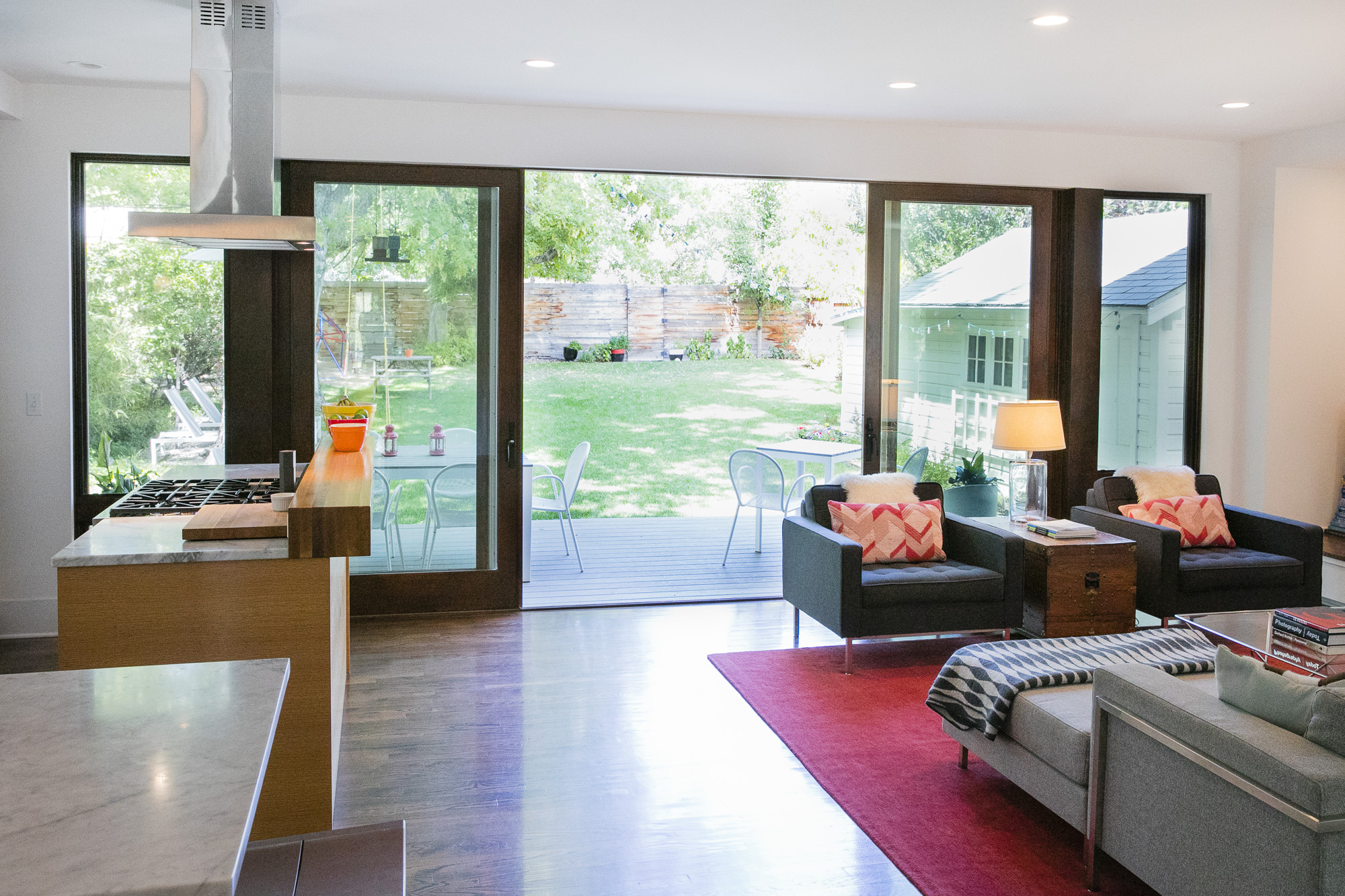
Step 5: Align Your Level of Investment with the Right System
The Options Have Never Been Wider
The range of glazing systems and door technologies available today is genuinely impressive. Bifold doors, folding glass walls, large pocket doors, operable skylights, full sliding glass wall systems, the options for connecting indoor and outdoor spaces have expanded significantly, and the best products perform beautifully.
But a wider range of options also means more decisions to get right.
Climate Is Part of the Equation
In Colorado, we have four distinct seasons. There are stretches of the year where opening an entire wall to the outside is a genuinely wonderful experience. There are also months where that same wall stays firmly closed.
A folding glass wall system is a meaningful feature in the right home. But it is worth asking honestly: how often will it actually be open? If the answer is a handful of weekends each summer, a well-considered set of sliding doors may serve the same lifestyle goal at a more appropriate level of investment, and leave room in the budget for decisions that affect the home year-round.
The same logic applies in Idaho's Wood River Valley, where the mountain climate shapes how outdoor living actually functions across the seasons. The right system is the one calibrated to how you live in that place, not the most impressive option available in a showroom.
Fit the Whole, Not the Statement
This is where we come back to Step One. The goal is never the most dramatic indoor-outdoor home connection we can create. It is the most fitting one for your site, your climate, your lifestyle, and your level of investment.
We help clients work through these decisions honestly. That means understanding the tradeoffs, knowing which systems perform well in Colorado and Idaho climates, and making sure every choice serves the whole home rather than a single memorable moment within it.
Ready to Get the Indoor-Outdoor Connection Right?
Every site is different. Every home is different. And every client comes to this process with a different set of goals, priorities, and ideas about how they want to live.
That is exactly why the indoor-outdoor home connection we design for one family in Boulder looks nothing like the one we design for another in Idaho's Wood River Valley — and why the process always begins with a conversation rather than a set of predetermined answers.
If you are thinking about building or remodeling a home in Colorado or Idaho and want to get the indoor-outdoor connection right, we would love to hear about your project. We bring the site knowledge, the design experience, and the commitment to service that makes these decisions feel manageable rather than overwhelming.
Contact bldg.collective to start the conversation. Or if you would like to see these ideas realized in actual work first, our project portfolio is a good place to begin.